The Intel Core i7-13705H is a high-end mobile CPU for laptops based on the Raptor Lake-H series (Alder Lake architecture). It was announced in early 2023 and offers 6 performance cores (P-cores, Golden Cove architecture) and 8 efficient cores (E-cores, Gracemont architecture). The P-cores support Hyper-Threading leading to 20 supported threads when combined with the E-cores. The clock rate ranges from 2.4 to 5 GHz (single core turbo, all-core 4.7 GHz) on the performance cluster and 1.8 to 3.7 GHz on the efficiency cluster. The performance of the E-cores should be similar to old Skylake cores (compare with the Core i7-6920HQ). All cores can use up to 24 MB L3 cache. Similar to the i7-13700H but without vPro support and the 13705H uses a different package and socket.
Performance
Thanks to the high core count and high clock speed, the Core i7-13705H should be similar to the old top model, the Core i9-12900HK. Therefore, the CPU is very well suited for all demanding use cases like gaming, content creation, and scientific calculations. The performance should be identical to the Core i7-13700H.
Features
The integrated memory controller supports various memory types up to DDR5-5200 (up from 4800 MHz for the 12th gen). The Thread Director (in hardware) can support the operating system to decide which thread to use on the performance or efficient cores for the best performance. For AI tasks, the CPU also integrates GNA 3.0 and DL Boost (via AVX2). Quick Sync in version 8 is the same as in the Rocket Lake CPUs and supports MPEG-2, AVC, VC-1 decode, JPEG, VP8 decode, VP9, HEVC, and AV1 decode in hardware. The CPU now supports PCIe 5.0 x8 for a GPU and two PCIe 4.0 x4 for SSDs.
The CPU is rated at 45 W base power (115 W PL2) but most laptops will use a PL1 of around 60 Watt. The SoC is manufactured in a 10nm process at Intel, which is known as Intel 7 (improved over the 12th Gen).
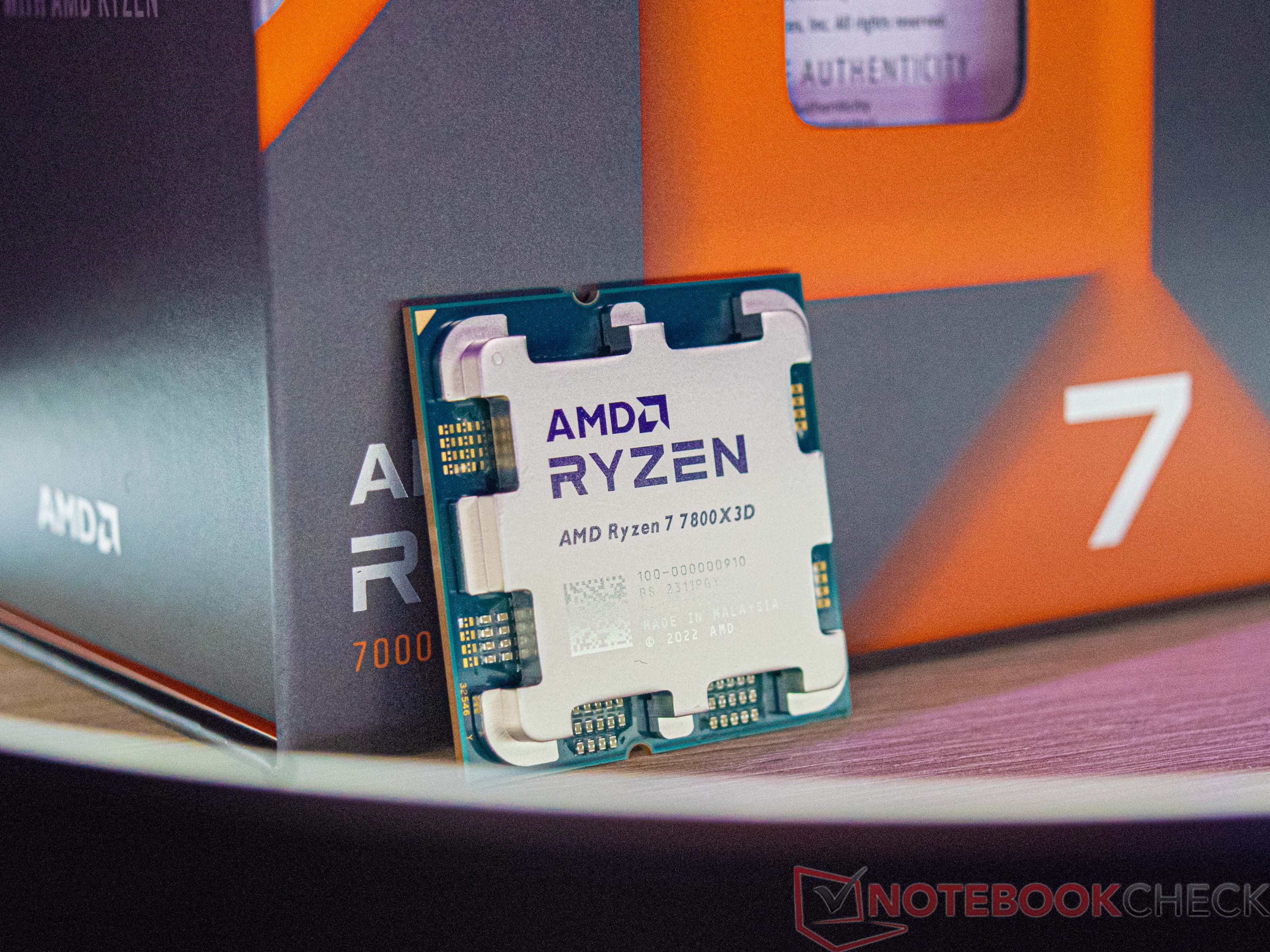
The AMD Ryzen 7 7800X3D is a high-end desktop processor from the Raphael series with 8 Zen 4 cores and SMT (Simultaneous Multithreading), allowing it to handle up to 16 threads simultaneously. After its announcement in January 2023 at CES in Las Vegas, it was launched in April 2023. Following the launch of the two top models, the AMD Ryzen 9 7900X3D and the AMD Ryzen 9 7950X3D, the third model was introduced, which offers significantly more gaming performance with the 3D V-Cache.
The CPU cores have a base clock of 4.2 GHz and can be boosted up to 5 GHz (single-core turbo). The AMD Ryzen 7 7800X3D features a CCD with 8 cores, which includes the fast 3D V-Cache. This differs significantly from the two Ryzen 9 models, as they have two CCDs, but only one of them can utilize the 3D V-Cache.
The performance of the AMD Ryzen 7 7800X3D is consistently good, although its multi-threaded performance suffers a bit due to the eight native compute cores. However, the real strength of the AMD Ryzen 7 7800X3D lies in gaming performance, where it excels. In tests, we see consistently high gaming performance, even surpassing that of an Intel Core i9-13900K.
In terms of power consumption, the AMD Ryzen 7 7800X3D aligns with the other two models featuring 3D V-Cache, making the 8-core processor extremely power-efficient. In numbers, this means that the AMD Ryzen 7 7800X3D is specified with a TDP of up to 120 watts. The PPT (Package Power Tracking) is also rated up to 162 watts. For comparison, an AMD Ryzen 9 7950X is specified with 170 watts (TDP) or 230 watts (PPT).
The Intel Core i9-13900H is a high-end mobile CPU for laptops based on the Raptor Lake-H series (Alder Lake architecture). It was announced in early 2023 and offers 6 performance cores (P-cores, Golden Cove architecture) and 8 efficient cores (E-cores, Gracemont architecture). The P-cores support Hyper-Threading leading to 20 supported threads when combined with the E-cores. The clock rate ranges from 2.5 to 5.2 GHz (single core turbo, all-core 4.8 GHz) on the performance cluster and 1.8 to 4 GHz on the efficiency cluster. The performance of the E-cores should be similar to old Skylake cores (compare with the Core i7-6920HQ). All cores can use up to 24 MB L3 cache. The CPU supports the full set of vPro Enterprise management features.
Performance
Thanks to the high core count and high clock speed, the Core i7-13800H should be faster than the older Core i9-12900HK. Therefore, the CPU is very well suited for all demanding use cases like gaming, content creation, and scientific calculations.
Features
The integrated memory controller supports various memory types up to DDR5-5200 (up from 4800 MHz for the 12th gen). The Thread Director (in hardware) can support the operating system to decide which thread to use on the performance or efficient cores for the best performance. For AI tasks, the CPU also integrates GNA 3.0 and DL Boost (via AVX2). Quick Sync in version 8 is the same as in the Rocket Lake CPUs and supports MPEG-2, AVC, VC-1 decode, JPEG, VP8 decode, VP9, HEVC, and AV1 decode in hardware. The CPU now supports PCIe 5.0 x8 for a GPU and two PCIe 4.0 x4 for SSDs.
The CPU is rated at 45 W base power (115 W PL2) but most laptops will use a PL1 of around 60 Watt. The SoC is manufactured in a 10nm process at Intel, which is known as Intel 7 (improved over the 12th Gen).
Average Benchmarks Intel Core i7-13705H → 100%n=23
Average Benchmarks AMD Ryzen 7 7800X3D → 105%n=23
Average Benchmarks Intel Core i7-13800H → 100%n=23
- Range of benchmark values for this graphics card - Average benchmark values for this graphics card * Smaller numbers mean a higher performance 1 This benchmark is not used for the average calculation
v1.35
log 08. 20:58:08
#0 ran 0s before starting gpusingle class +0s ... 0s
#1 checking url part for id 14986 +0s ... 0s
#2 checking url part for id 15064 +0s ... 0s
#3 checking url part for id 14719 +0s ... 0s
#4 redirected to Ajax server, took 1765223888s time from redirect:0 +0s ... 0s
#5 did not recreate cache, as it is less than 5 days old! Created at Sun, 07 Dec 2025 05:18:56 +0100 +0s ... 0s
#6 composed specs +0.006s ... 0.006s
#7 did output specs +0s ... 0.006s
#8 getting avg benchmarks for device 14986 +0.004s ... 0.01s
#9 got single benchmarks 14986 +0.006s ... 0.015s
#10 getting avg benchmarks for device 15064 +0.004s ... 0.019s
#11 got single benchmarks 15064 +0.006s ... 0.025s
#12 getting avg benchmarks for device 14719 +0.001s ... 0.027s
#13 got single benchmarks 14719 +0s ... 0.027s
#14 got avg benchmarks for devices +0s ... 0.027s
#15 min, max, avg, median took s +0.054s ... 0.081s





 - Average benchmark values for this graphics card


