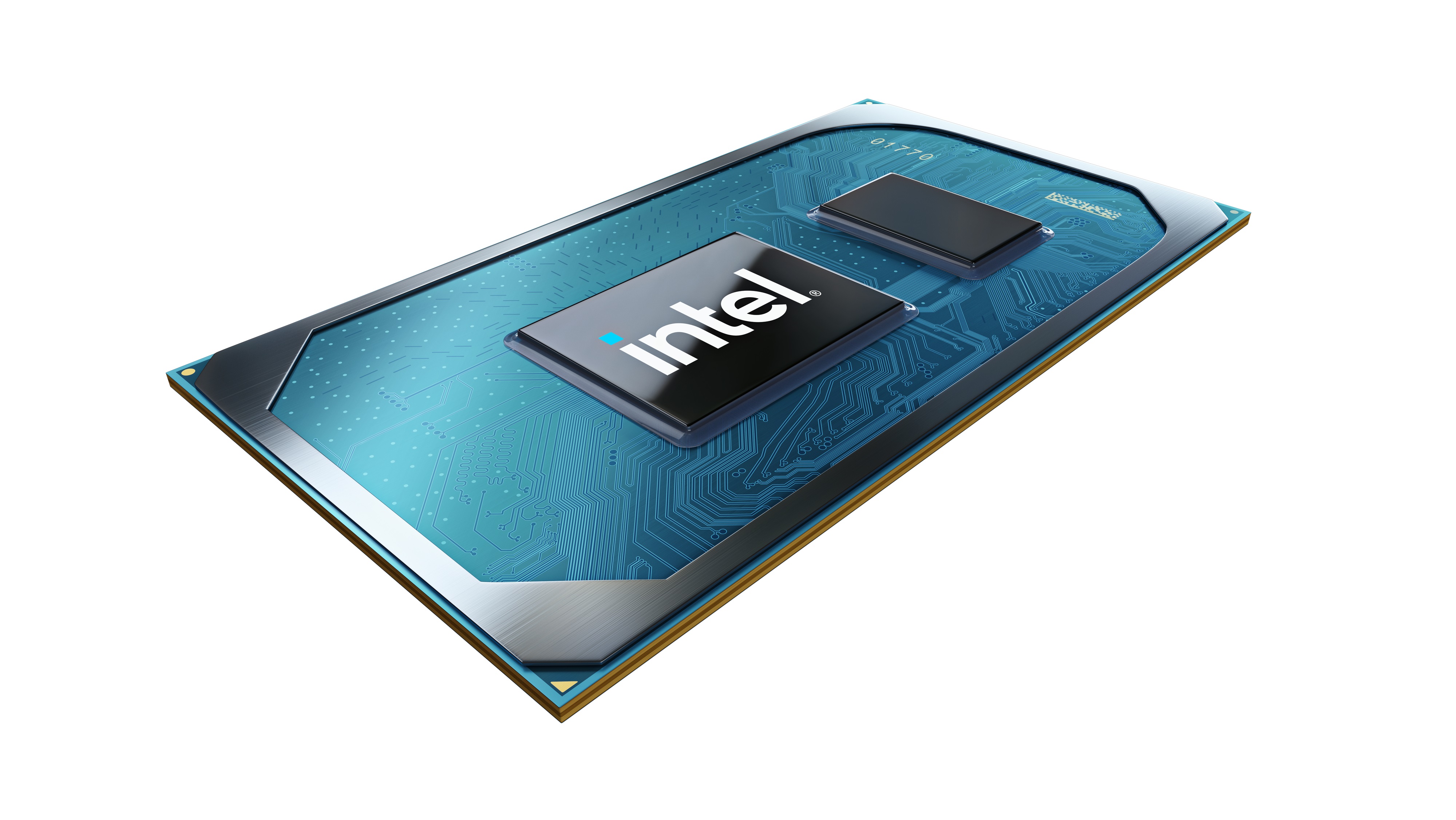
The Intel Core i7-1280P is the flagship Alder Lake-P CPU, which is to say, an expensive 28 W part meant for use in ultra-light (yet actively cooled) laptops. This CPU was announced in early 2022 and it has 6 performance cores (P-cores, Golden Cove architecture) mated to 8 efficient cores (E-cores, Gracemont architecture). The P-cores are Hyper-Threading-enabled for whopping 20 threads when combined with the E-cores. The clock speeds range from 1.8 GHz to 4.8 GHz for the performance cluster and 1.3 GHz to 3.6 GHz for the efficiency cluster. This is the only hexa-core 28 W Alder Lake CPU as of February 2022, trumping what the more affordable i7-1270P and i7-1260P have in store. Full vPro feature set is supported by this Core i7 ("Enterprise" tier, allowing for remote device management).
Architecture
The i7 is a continuation of Intel's efforts to use the ARM-developed big.LITTLE technology for its own benefit. A single "little" Alder Lake core is supposed to be just as fast as a Skylake core (as found in the venerable Core i7-6700HQ among other options) which is six years old at this point. All of a Core i7-1280P's CPU cores enjoy access to 24 MB of L3 cache. The integrated memory controller supports up to 64 GB of LPDDR5-5200, DDR5-4800, LPDDR4x-4267 or DDR4-3200 RAM. Just like the other 12th Gen Intel Core processors, Core i7-1280P comes with Thread Director which is a new functionality designed to help Windows 11 decide which cores to use for what workload for best performance and efficiency possible. Hardware acceleration of AI algorithms is supported via GNA 3.0 and DL Boost (via AVX2). PCI-Express 5.0 support has not found its way into Alder Lake P processors, so users will have to be content with PCI-Express 4.0 for the time being. Four PCI-Express 4 lanes allow for a read/write rate of up to 7.9 GB/s, provided a suitably fast NVMe SSD is used.
Please note this is not a user-replaceable CPU. It gets soldered permanently on to the motherboard (BGA1744 socket interface).
Thanks to its decent cooling solution and a long-term CPU power limit of 80 W, the MSI Summit E16 Flip A12UDT-031 is among the fastest laptops built around the 1280P that we know of. It can be roughly 60% faster in CPU-bound workloads than the slowest system featuring the same chip in our database, as of August 2023.
Graphics
The built-in graphics adapter in the form of the 96 EU Iris Xe running at up to 1.45 GHz has seen no change from what was built into the 11th Gen Tiger Lake-UP3 processors, like a i7-1165G7, which is hardly a downside as this iGPU is loaded with modern features such as AV1 video decoding capability and SUHD 4320p monitor support. An Iris Xe Graphics G7 will let you use up to 4 monitors simultaneously, provided the laptop has the ports required.
The graphics adapter will let you play most games at 1080p / Medium settings to be very close to NVIDIA's MX350.
That being said, the Xe's gaming performance is bound to be tied to how high the Power Limits and how competent the cooling solution of a laptop are. Fast RAM is a prerequisite for decent performance as well (the Iris Xe has to make do with no dedicated video memory).
Last but not the least, we discovered that the GPU utilization when playing YouTube UHD 2160p60 videos is higher than it was with Tiger Lake chips.
Power consumption
The i7's base power consumption (also known as the default TDP value or the PL1) is 28 W, with 64 W being its maximum Intel-recommended Turbo power consumption (also known as the PL2). The "Minimum Assured" power consumption is fairly high at 20 watts. All in all, an active cooling solution is a must for a CPU like this.
The i7-1280P is built with Intel's fourth-gen 10 nm process marketed as Intel 7 for decent, as of late 2022, energy efficiency. This is still a rather power-hungry CPU; a single P-core will happily eat more than 20 W and even ask for more when under heavy load. A couple of higher-end 7 nm U-class AMD Ryzen 5000 chips are noticeably more modest than the i7 while delivering the same or higher performance levels.
The Intel Core i7-1195G7 is a quad-core SoC from the Tiger Lake-UP3 product family designed for thin laptops and Ultrabooks that was introduced in 2021. It integrates four Willow Cove processor cores (8 threads thanks to Hyper-Threading). The base clock (minimum) depends on the configured TDP and can range from 1.3 GHz (12 Watt TDP) up to 2.9 GHz (28 W). The Turbo on one core can reach up to 5 GHz (Turbo Boost 3.0). All cores can reach up to 4.6 GHz. The i7-1195G7 is part of the Tiger Lake UP3 refresh and is the fastest CPU of the Tiger-Lake U line.
Furthermore, Tiger Lake SoCs supports four lanes of PCIe 4, AI hardware acceleration, and the partial integration of Thunderbolt 4/USB 4 and Wi-Fi 6E in the chip.
The 1195G7 integrates the Intel Iris Xe graphics adapter with 96 EUs clocked at 400 - 1400 MHz. The GPU and CPU can together use the 12 MB of L3 cache.
Performance
The average 1195G7 in our database matches the Intel Core i5-10300H in multi-thread performance while, perhaps surprisingly, lagging behind the AMD Ryzen 3 5300U. The makes the i7 a decent lower mid-range chip, as of early 2022. It'll run most apps with virtually no delays or slowdowns which is what the vast majority of users wants.
Thanks to its decent cooling solution and a long-term CPU power limit of slightly more than 30 W, the VAIO SX14 VJS144X0111K is among the fastest laptops built around the 1195G7 that we know of. It can be about 40% faster in CPU-bound workloads than the slowest system featuring the same chip in our database, as of August 2023.
Power consumption
This Core i7 series chip has a default TDP of 12 W to 28 W, the expectation being that laptop makers will go for a higher value in exchange for higher performance. Either way, that's a tad too high to allow for passively cooled designs.
The i7-1195G7 is built with Intel's 3rd generation 10 nm process marketed as SuperFin for below average, as of early 2023, energy efficiency.
- Range of benchmark values for this graphics card - Average benchmark values for this graphics card * Smaller numbers mean a higher performance 1 This benchmark is not used for the average calculation
v1.35
log 13. 18:51:06
#0 ran 0s before starting gpusingle class +0s ... 0s
#1 checking url part for id 14059 +0s ... 0s
#2 checking url part for id 13181 +0s ... 0s
#3 redirected to Ajax server, took 1765648266s time from redirect:0 +0s ... 0s
#4 did not recreate cache, as it is less than 5 days old! Created at Sat, 13 Dec 2025 05:18:51 +0100 +0s ... 0s
#5 composed specs +0.007s ... 0.008s
#6 did output specs +0s ... 0.008s
#7 getting avg benchmarks for device 14059 +0.003s ... 0.011s
#8 got single benchmarks 14059 +0.012s ... 0.023s
#9 getting avg benchmarks for device 13181 +0.003s ... 0.026s
#10 got single benchmarks 13181 +0.012s ... 0.039s
#11 got avg benchmarks for devices +0s ... 0.039s
#12 min, max, avg, median took s +0.043s ... 0.082s









 - Average benchmark values for this graphics card


