


Sodium-ion battery allows fast charging and longer lifespan with graphene shell

While sodium-ion batteries have a lot going for them, such as cheap and abundant raw material, safer chemistry, and stellar performance in freezing temps, the cells usually trade one strength for another. While they can charge quickly, fast charging wears them out sooner than the ubiquitous LFP chemistry in mass electric vehicles.
They can be built for a longer lifespan, too, but they will then have to be charged slowly. A new study from the research and production center of sodium-ion batteries - China - indicates that the tradeoff can be avoided entirely.
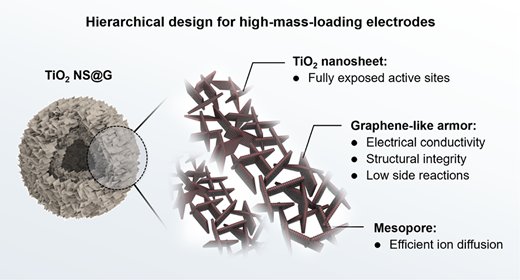
The research team built an anode from titanium dioxide nanosheets, each only around 10 nm across, assembled into hollow double-shelled spheres. Each sheet is wrapped in a graphene-like carbon coating that is just 0.4 nm thick. The coating lifts conductivity from 1.86 × 10⁻⁸ S/cm for the bare material to 3.55 × 10⁻⁴ S/cm. Simply mixing in graphene did almost nothing, so the structural anode wrapping in a graphene shell is another innovation.
The results were pretty striking, as at an ultrafast 10C rate of charging that only takes six minutes, the anode kept going for 10,000 cycles and delivered 131 mAh/g. Even at 100C, which works out to a full charge in roughly half a minute, it still gave 121 mAh/g. The bare nanosheets collapsed after only 400 cycles, while the version armored with the graphene-like shell stayed intact.
Mass loading, a common weak spot in lab results, also held up. Electrodes up to 10.5 mg/cm² delivered 2.13 mAh/cm² at slow rates and kept 0.567 mAh/cm² at high current. Above 1 A/g, the team found, commercial hard carbon loses its low voltage plateau and fades quickly, while this anode keeps delivering. The researchers also built a full cell with a sodium vanadium phosphate cathode, which held up over 170 cycles at 2 A/g.
Fast Na-ion battery charging vs. lifespan
For a battery, fast charging and long life pull in opposite directions because both depend on how the electrode behaves at its surface and how it handles stress. Charging speed needs small, exposed structures, but sodium ions are bigger than lithium ions and move sluggishly through solid materials. The material needs to be shrunk into tiny nanosheets so ions only travel a short distance and can store on the surface, which creates an excessive amount of surface area. The bare nanosheets in the paper measured 261 m²/g against 76 m²/g for ordinary nanoparticles, for instance.
Long battery life needs the opposite since every bit of exposed surface reacts with the electrolyte and the protective film keeps growing and consuming sodium. In the paper's data, the bare nanosheets lost nearly half their sodium on the first cycle (55.6% initial efficiency), versus 80.1% for the armored version. Fast charging also forces ions in quickly, which makes the electrode swell and shrink hard each cycle. Fragile nanosheets crack, the film breaks and forms again, and the structure eventually falls apart. The bare nanosheets had, in fact, collapsed after just 400 cycles. The graphene wrapping, however, conducts electrons so the nanosheets can run fast while also acting as a shell that holds the sheets together and limits direct contact with the electrolyte. The analysis showed a thinner, more inorganic sodium phosphate film forming on the armored version, which gives the speed of nanostructuring without paying the full durability cost.
Everything was tested in small coin cells, and the half cell tests used sodium metal as the counter electrode. The anode also runs at a higher average voltage than hard carbon, which cuts the energy a full cell can deliver at normal rates. The anode now needs to be tested in a full cell that mimics a normal battery environment, but this is still the kind of progress sodium-ion tech needs. Companies like CATL and HiNa are already pushing sodium cells toward vehicles and grid storage, and a more durable fast-charging anode would strengthen their case. Sodium-ion batteries are already verging on price and energy density parity with LFP ones, so removing the charging speed and lifespan conundrum from the equation would see them into more electric cars.
Get the AOC sodium-ion jump starter with air compressor on Amazon
 Add as a preferred source on Google


