




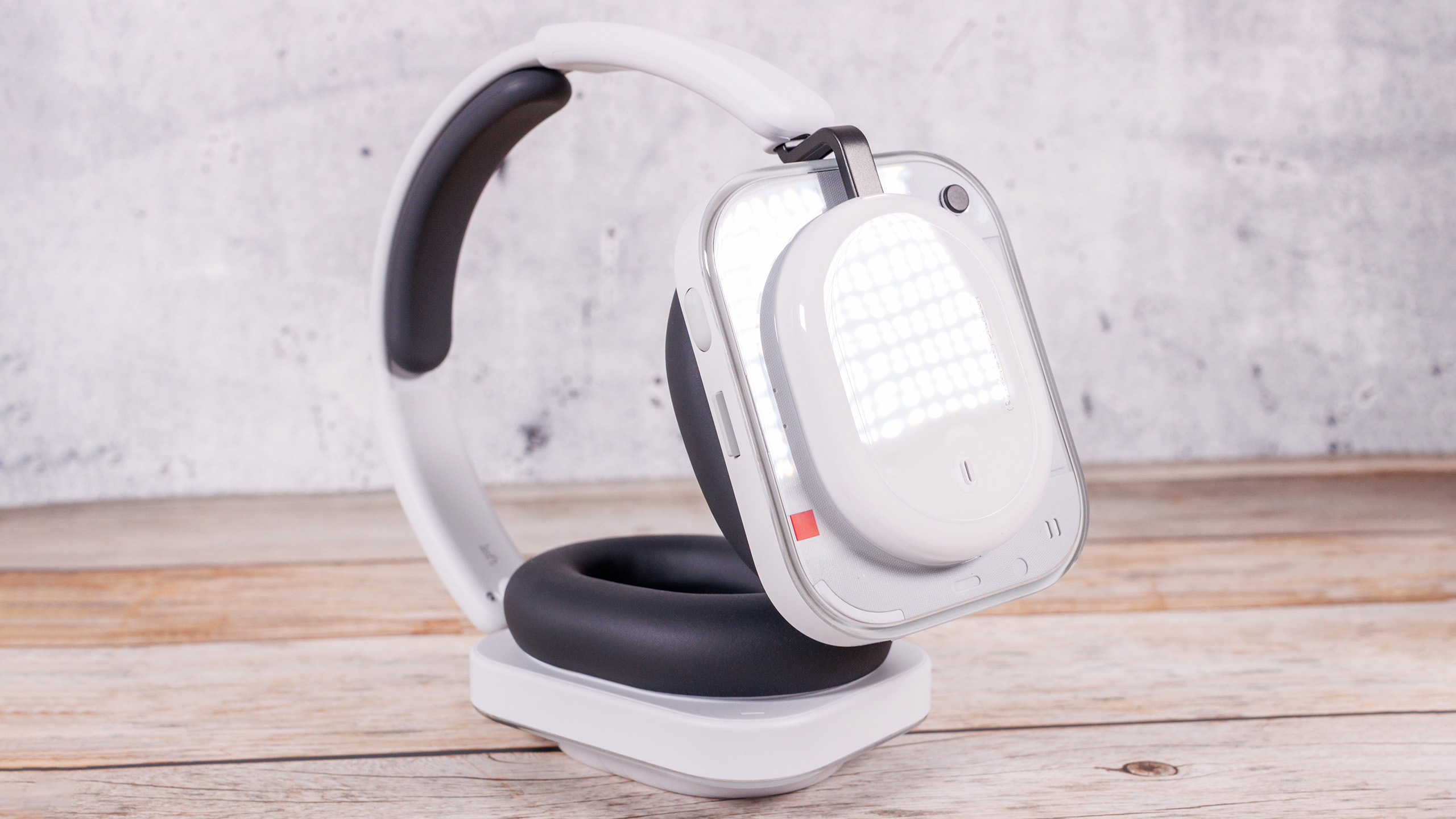
Conclusion on the Nothing Headphones (a)
With the Nothing Headphones (a), Nothing has made a compelling entry into the more affordable over-ear category. Despite the significantly lower price compared to the Headphones (1), users have to make surprisingly few compromises. The headphones impress with a distinctive design, excellent build quality, high comfort, and intuitive controls via physical buttons, which are significantly more practical for everyday use than many of the competition’s touch-based solutions.
In terms of sound, the Headphone (a) deliver a lively and engaging sound signature that’s particularly well-suited for music, movies, and podcasts. While the sound lacks some of the precision and depth of the more expensive model, the performance offered is absolutely competitive in this price range. ANC and transparency mode also work reliably, though not at the very top level.
The biggest strength, however, is the enormous battery life. Even with ANC and LDAC enabled, the Nothing Headphones (a) are among the longest-lasting over-ear headphones in their class, making them ideal for travel and long workdays.
Pros
Cons
Price and availability

Table of Contents
- Conclusion on the Nothing Headphones (a)
- Specifications: Nothing Headphone (a)
- Body and ergonomics - Lots of plastic in a sleek design
- Sustainability - Nothing is a little transparent
- Features and Operation - No compromises compared to the more expensive model
- Sound - High-quality headphones from Nothing
- Battery life - Seems endless
Specifications: Nothing Headphone (a)
| Wearing Style | Over-ear |
| Connectivity | Bluetooth 5.4 (Multipoint), USB, 3.5 mm jack |
| Range | Up to 10 m |
| Speakers | 40 mm, titanium-coated PEN- and PU-diaphragm, 20–40,000 Hz |
| Audio Codecs | SBC, AAC, LDAC |
| Battery Capacity | 1,060 mAh |
| Charging Port | USB-C |
| Weight | 310 g |
| Firmware Version | 1.0.1.51 |
| Package Contents | Headphones, carrying case, audio cable, USB cable |
| Price (RRP) | $199 |
Following its over-ear debut with the Nothing Headphones (1), Nothing released the CMF Headphone Pro, an affordable model. Now, with the Headphones (a), Nothing is also entering a lower-priced segment while remaining true to its design philosophy.
These over-ear headphones aim to impress with long battery life, exceptional design, traditional controls, ANC, and high-quality sound. That’s a big promise for just $199. Read the review to find out if they deliver.
Body and ergonomics - Lots of plastic in a sleek design
The Nothing Headphone (a) is available in four color options: white, black, pink, and yellow. Unlike the Headphone (1), Nothing has opted not to use aluminum, which makes the a model feel slightly less premium. However, even with its plastic construction, the design is a real eye-catcher; the build quality leaves a very good impression, and despite the choice of materials, the headphones don’t look cheap.
The large, soft ear cushions offer a high level of comfort, and the clamping force of the Headphone (a) is not too strong. Due to the closed design, the ears are not well ventilated; nevertheless, we did not find wearing them for several hours to be uncomfortable.
The headphones are IP52-rated, protecting against the ingress of harmful amounts of dust and against falling water droplets.


Sustainability - Nothing is a little transparent
The Nothing Headphones (a) come in plastic-free packaging. Nothing states that the product’s CO2e footprint is 12.6 kg, and renewable energy is used during final assembly.
There are no replacement parts available for the headphones. Additionally, the ear cushions cannot be replaced by the user.
Features and Operation - No compromises compared to the more expensive model
Both Google Fast Pair and Microsoft Swift Pair are available for connecting the Nothing Headphones (a). If you prefer to pair the headphones manually via Bluetooth, there is a discreet button on the inside of the headphones for this purpose. Alternatively, the headphones can also be used via USB-C or the 3.5-mm jack. However, there is no passive mode, so the headphones cannot be used when the battery is dead. They are turned on using a slide switch.
Controls are operated either via the paired device or directly using the physical buttons on the Nothing Headphones (a). For this purpose, there is a so-called roller that can be turned to adjust the volume and, when pressed, triggers various functions such as play/pause or a switch between ANC and transparency mode (when held down). Additionally, there is a paddle that allows you to skip to the previous or next track; if you hold it down longer, fast-forwarding is possible—provided the app supports it. The AI button activates a voice or AI assistant.
The Nothing X app allows you to adjust numerous settings and install firmware updates. You can also view and customize the button assignments here.


Sound - High-quality headphones from Nothing
The sound on the Nothing Headphones (a) isn't tuned by KEF, yet the headphones deliver a lively listening experience and are a joy to use with all types of media content. However, they fall a bit short on bass in the default settings, which is why we adjusted this using the equalizer; additionally, the sound isn't quite as clear as on the more expensive model. That said, this will likely only bother audiophiles, as the right sound source is also a key factor here.
Thanks to LDAC, a high-quality Bluetooth codec is available, and USB as well as the 3.5-mm jack can be used as input sources. The Nothing Headphones (a) also offer support for Spatial Audio, customizable equalizers, and a bass booster.
The transparency mode operates with low noise, and the active noise cancellation (ANC) is effective, though it falls short of the performance of the Headphone (1) and doesn’t reach the level of Bose and similar manufacturers.
Phone calls are reproduced clearly through the headphones, though the voice of the Nothing Headphone (a) user sounds somewhat muffled and metallic.
| Loudspeakers | |
| THD | |
| Teufel Real Blue Pro (RMS: -0.6 dBFS) | |
| Nothing Headphone (a) (RMS: -2.3 dBFS) | |
| Nothing Headphone (1) (RMS: -1.1 dBFS) | |
| THD+N | |
| Teufel Real Blue Pro (RMS: -0.6 dBFS) | |
| Nothing Headphone (1) (RMS: -1.1 dBFS) | |
| Nothing Headphone (a) (RMS: -2.3 dBFS) | |
* ... smaller is better
THD (Total Harmonic Distortion): Harmonic distortion quantifies the magnitude of the components that arise from non-linear distortion (harmonic content) in relation to the original signal. THD refers only to the fundamental harmonic content. The distortion factor is often mentioned in the same breath, but refers to the overall signal.
THD+N (Total Harmonic Distortion + Noise): This value is comparable to THD, but in addition to the interference from harmonics, the interference from noise is also recorded as an effective value.
For the measurement, a low-harmonic sine wave signal (1 kHz, > 0 dB) is played through the headphones to be tested and recorded by a linear measuring microphone (measuring distance: approx. 1 cm) in an artificial head.
Nothing Headphone (a) audio analysis
(+) | speakers can play relatively loud (90.8 dB)
Bass 100 - 315 Hz
(+) | good bass - only 3.3% away from median
(+) | bass is linear (3.2% delta to prev. frequency)
Mids 400 - 2000 Hz
(+) | balanced mids - only 1.7% away from median
(+) | mids are linear (2.8% delta to prev. frequency)
Highs 2 - 16 kHz
(+) | balanced highs - only 4% away from median
(+) | highs are linear (4.1% delta to prev. frequency)
Overall 100 - 16.000 Hz
(+) | overall sound is linear (6.9% difference to median)
Compared to same class
» 1% of all tested devices in this class were better, 0% similar, 99% worse
» The best had a delta of 4%, average was 24%, worst was 134%
Compared to all devices tested
» 1% of all tested devices were better, 0% similar, 99% worse
» The best had a delta of 4%, average was 24%, worst was 134%
Teufel Real Blue Pro audio analysis
(+) | speakers can play relatively loud (97.1 dB)
Bass 100 - 315 Hz
(±) | reduced bass - on average 7.5% lower than median
(+) | bass is linear (3.5% delta to prev. frequency)
Mids 400 - 2000 Hz
(+) | balanced mids - only 2.8% away from median
(+) | mids are linear (2.2% delta to prev. frequency)
Highs 2 - 16 kHz
(+) | balanced highs - only 3.9% away from median
(+) | highs are linear (3.8% delta to prev. frequency)
Overall 100 - 16.000 Hz
(+) | overall sound is linear (9.5% difference to median)
Compared to same class
» 4% of all tested devices in this class were better, 1% similar, 95% worse
» The best had a delta of 4%, average was 24%, worst was 134%
Compared to all devices tested
» 4% of all tested devices were better, 1% similar, 95% worse
» The best had a delta of 4%, average was 24%, worst was 134%
Battery life - Seems endless
The battery life is rated at up to 135 hours. Using LDAC and ANC reduces this to 62 hours. Thanks to the fast-charging feature, the headphones can be fully charged in two hours. Just five minutes of charging provides about five hours of playback time (with ANC).
In everyday use, the Nothing Headphone (a) feels like it lasts forever, and even on long trips with extended flights, we didn’t have to recharge them even once.
Transparency
The selection of devices to be reviewed is made by our editorial team. The test sample was given to the author by the manufacturer free of charge for the purposes of review. There was no third-party influence on this review, nor did the manufacturer receive a copy of this review before publication. There was no obligation to publish this review. As an independent media company, Notebookcheck is not subjected to the authority of manufacturers, retailers or publishers.
This is how Notebookcheck is testing
Every year, Notebookcheck independently reviews hundreds of laptops and smartphones using standardized procedures to ensure that all results are comparable. We have continuously developed our test methods for around 20 years and set industry standards in the process. In our test labs, high-quality measuring equipment is utilized by experienced technicians and editors. These tests involve a multi-stage validation process. Our complex rating system is based on hundreds of well-founded measurements and benchmarks, which maintains objectivity. Further information on our test methods can be found here.
 Add as a preferred source on Google


