


A selfie as a health check? AI detects health risks and biological age from a facial photo

An interesting study was recently published in the journal The Lancet Digital Health. In the study, researchers developed an AI model called FAHR-Face (Foundation Artificial Intelligence for Health Recognition). It was trained on more than 40 million facial images and subsequently adapted for two key tasks. The two models capture different types of information:
- The first AI model analyzes facial features and estimates a person's biological age. This can differ from their chronological age and may provide insights into their overall health and physical resilience.
- The second model estimates the survival risk of cancer patients based on a facial photo. Areas beneath the eyes and along the bridge of the nose appeared to be particularly important for making these predictions.
How reliable were the results?
Overall, the researchers were allowed to evaluate the AI model on around 43,000 cancer patients. A separate test was then conducted on 3,820 patients. The model classified 122 of them as belonging to the highest-risk group. Of those patients, 52 percent died within 90 days.
The model classified 975 patients as belonging to the lowest-risk group. Only 2 percent of them died during the same period.
Significance
One major advantage of this approach would be its low technical and financial barriers to entry. Anyone can take a simple facial photo in seconds.
However, a definitive causal relationship has not yet been established. The AI identifies statistical patterns but does not automatically explain which biological processes cause them. It also remains unclear whether the findings can be applied to people with other medical conditions.
Potentially concerning applications could also include tracking and video surveillance.
Conclusion
AI can apparently extract information from a single facial photo that is associated with biological age and the risk of death among cancer patients. In the study, the association remained even after accounting for clinical prognostic factors. However, it has yet to be conclusively established how much additional predictive value a facial photo actually offers compared with established clinical methods.
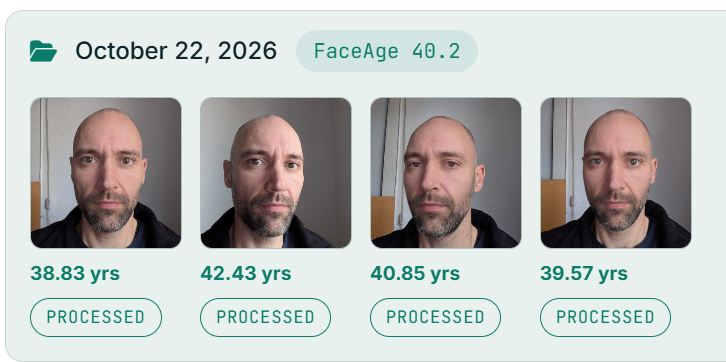
Anyone who wants to try estimating their own biological age using facial AI can register on this website and take part in the “public study.” Users can upload between 3 and 10 photos of their face, either once or daily if they prefer. The system then provides an individual biological age score for each image, along with an overall score. Privacy is protected: photos are not shared and are deleted after a certain period. Other information is anonymized and made available to additional researchers.
 Add as a preferred source on Google


